
Free companion · The four trauma responses
Four Ways of Leaving the Room
Everybody leaves. You just leave in your own particular way.
When a moment gets bigger than your nervous system can hold, your body does something to get you out of it, and it tends to do the same something every time. That's your trauma response. It isn't a character flaw and it isn't a diagnosis, it's the exit your body learned back when leaving was the only safe move on offer. There are four of them. This two-page companion shows you all four side by side.
What it is
Two pages that lay the four trauma responses out where you can see them together: fawn, fight, flight and freeze. For each one, what it looks like from the inside, what it costs you, what it was protecting, and the smallest move back toward yourself. Not a diagnosis and not a personality type. A map, offered so you can decide where you sit on it.
Your response isn't the enemy here. The same wiring that had me managing everyone else's mood like weather is the wiring that makes me useful at a hospital bedside, where reading a room is the whole job. The trouble starts when the pattern runs without asking you first.
What is inside
-
The four exits
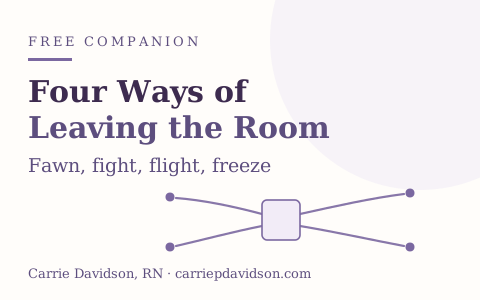
One diagram showing a single hard moment and the four ways out of it, so you can see the shape of the thing before you read a word about it.
-
Four honest cards
What each response looks like, what it costs, what it protects, and one small specific way back. Written without shame, because shame is what built most of these in the first place.
-
Two practices
The Ten-Second Landing and the First Reach: how to catch your pattern working in real time, which is the move everything else rests on.
If you already know which response is yours, this is the page to keep somewhere you'll see it. If you don't, the three-minute quiz will tell you, and then the companion will make sense of the answer.
Format and size
- Format
- PDF, two pages (printable)
- Size
- About 123 KB
- Access
- Free. Your email unlocks it here and brings the Sunday Letter.
This companion is education and reflection, not therapy, diagnosis, or medical treatment, and it isn't a substitute for care from a licensed mental-health or medical professional. If you're in crisis, the resources at the bottom of this page can help right now.
Read alongside it
Where this fits
-
The Conscious Creation Method
The companion names the four patterns. The Method page is the road out of them: awareness, regulation, creation, and the pause that everything else turns on.